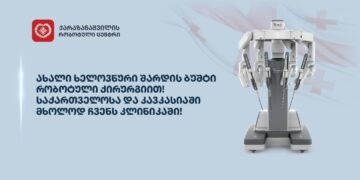



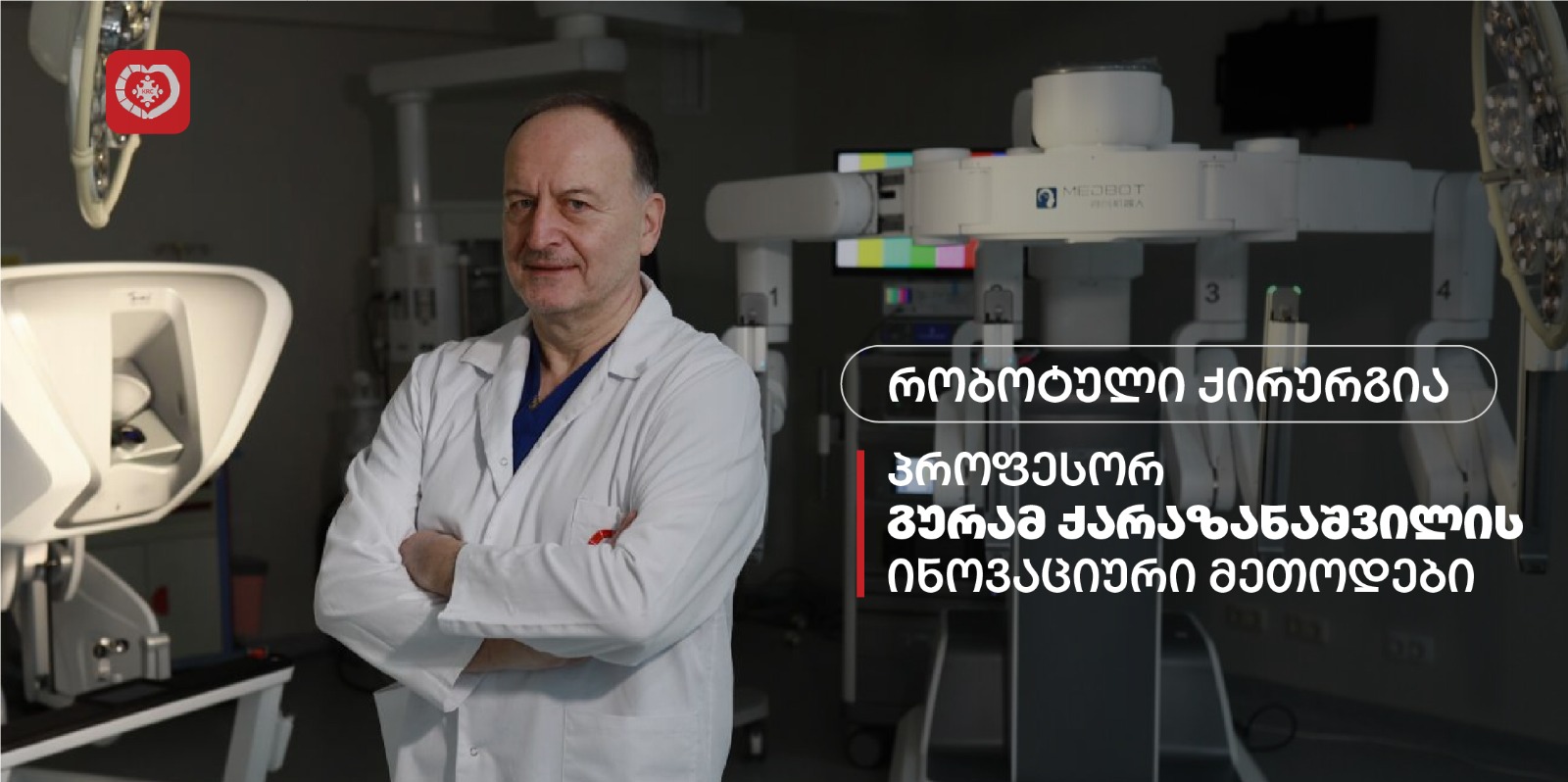
On February 27, 2024, the first robotic surgery in Tbilisi was performed, which had no analogue in Georgia and the Caucasus region.
The surgeon was not standing at the operating table – he controlled the system from a console, viewed tissues with tenfold magnification, and operated with millimeter precision. From that day, citizens of Georgia gained an opportunity that had previously been available only in European or American clinics.
The change did not happen suddenly. Behind all this stand decades of professional work, thousands of surgeries, international research, and scholarships — and the founder of robotic surgery in Georgia and the Caucasus, President of the Georgian Association of Oncological Urology, Doctor of Medical Sciences, globally recognized urologist and onco-urologist Professor Guram Karazanashvili.
For many years, for Georgian patients, such complex oncological interventions as surgeries for prostate, kidney, or bladder cancer automatically meant traveling abroad and receiving treatment there. Along with this came the language barrier, being far from home, psychological stress, and expenses that often exceeded the cost of the surgery itself by three to four times.
There was a problem of accessibility of such technology on the Georgian market.
Urologist Guram Karazanashvili is a Doctor of Medical Sciences, professor, and laureate of the Georgian National Prize – an award granted to him for outstanding achievements in prostate cancer research. For more than 30 years, he has worked based on the experience of leading clinics in Germany, Sweden, the Netherlands, Austria, and the United States.
He has been a full member of the European Association of Urology since 1996, of the American Association since 2010, and a member of the executive committee of the World Federation of Urological Oncology since 2018. He is a scholarship holder of the Alexander von Humboldt Foundation, a former reviewer of the journal European Urology, and a two-time winner of grants from the Shota Rustaveli National Science Foundation.
In 2017, he founded the “Georgian Association of Oncological Urology” and remains its president to this day. He spent more than ten years in the world’s leading clinics in Bonn, Malmö, Berlin, Vienna, Nijmegen, Florida, and China. It was precisely this experience that became the foundation of the project now called the “Karazanashvili Robotic Center.”
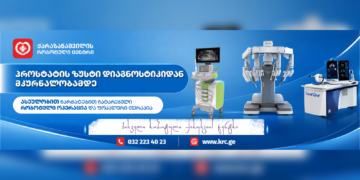
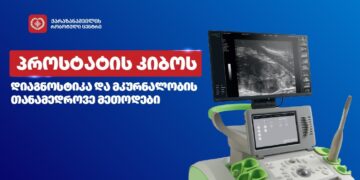
The implementation of robotic surgery did not mean merely purchasing an expensive system. It was preceded by systematic, step-by-step preparation. The clinic first introduced 29-megahertz micro-ultrasound – the latest technology available in Georgia and the Caucasus only in our clinic. It provides imaging improved by 300% compared to traditional ultrasound. The procedure is fast and accessible. Then came Focal One, focal therapy for prostate cancer that destroys tumor lesions while preserving the organ. Then transperineal fusion biopsy, the Storz stone fragmentation center, and so on. Every stage was a logical step toward the final and most large-scale breakthrough.
More than 9 million GEL in investments, Toumai – a fourth-generation robotic system that is the 2025 leader in telesurgery – and a team of doctors specially trained in Chinese training centers with the support of colleague surgeons from Sweden, Germany, and Spain.
In two years, the threshold of 100 surgeries, considered a “successful program” in many European centers, was surpassed within a single quarter. Today, the Karazanashvili Robotic Center is the only place in Georgia and the Caucasus where robotic surgery fully functions for patients from Georgia, Azerbaijan, Armenia, Kazakhstan, the Netherlands, and even the United States.
The surgeon controls every movement from the console, while the robot executes commands in a way the human hand could not: without tremor, with 360-degree rotation, and 3D visualization in areas where laparoscopy can no longer physically reach.
The Toumai system is enhanced with tactile feedback – the surgeon not only sees but also “feels” tissue resistance. In practice, this detail is crucial: it means that all structures determining the patient’s quality of life after surgery are protected to the maximum extent possible.
The practical result for the patient is less pain and almost zero blood loss. A surgery that required two months of rehabilitation with the open method is no longer relevant in the case of this approach.
The center’s specialization is broad. Onco-urology – tumors of the prostate, kidney, and bladder – is the main direction where robotic surgery is especially effective: oncological precision and preservation of a functional organ within a single operation.
Particularly noteworthy is the creation of an artificial bladder – a surgery in which a new organ is formed inside the body from a fragment of the intestine, without any external incision. Only 9% of American onco-urologists perform this surgery. The Karazanashvili Center introduced it for the first time in the Caucasus and now performs it regularly.
In addition, kidney-preserving surgeries are performed (including tumors up to 7 centimeters in size), gynecological interventions for cervical cancer and fibroids, and colorectal surgery – all those fields where precision and minimal trauma have an enormous impact on the patient’s future quality of life.
More than 300 surgeries in 2 years, a 10–15% share of foreign patients with a growing trend from Azerbaijan, Armenia, Kazakhstan, the Netherlands, and the United States, presentations at congresses in Europe, America, London, Edinburgh, Madrid, Strasbourg, Yerevan, and Baku, where international colleagues are also introduced to the Georgian experience – all this confirms the reliability of the clinic.