


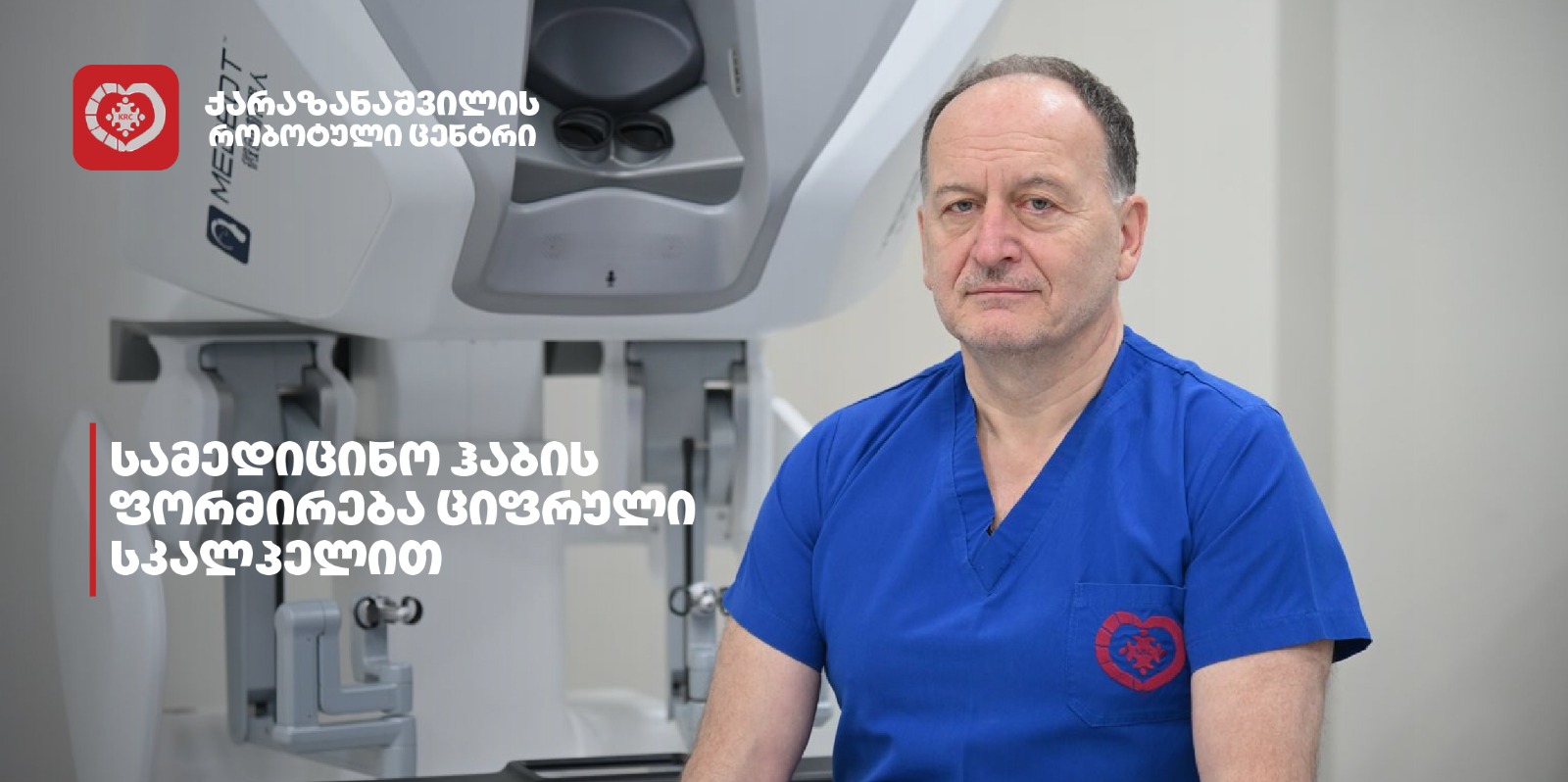
Robotic surgery has become one of the most important achievements of modern medicine and a rapidly developing field. Its introduction in Georgia and the Caucasus is associated with the name of the well-known doctor and scientist, Guram Karazanashvili. At the “Karazanashvili Robotic Center” (KRC), founded by him, where more than 9 million GEL has been invested, more than 300 complex robotic surgeries have been performed since February 27, 2024, up to the present day. Guram Karazanashvili spoke to us about the experience accumulated along this path and the systematic development.
Author: Iza Gvaramadze
How does robotic surgery differ from traditional surgery? Why did you decide to introduce it?
I had to work as a surgeon and urologist during a period full of challenges, when the medical field was undergoing evolution with giant steps caused by the technological revolution. My agenda, starting from my student years up to today, has been to stay on the front line of the world’s leading achievements. This is exactly what led me to become a Doctor of Medical Sciences, professor, laureate of the national award, member of the executive committee of world urologic oncology, president of the Georgian Association of Oncological Urology, expert of the Ministry of Health in urology, and finally – a robotic surgeon.
Today, robotic surgery represents a standard for leading clinics in developed countries. It is no longer a technology of the future, but a necessity, because it offers unprecedented opportunities to both the patient and the surgeon.
Before this, medicine went through stages including open surgery, endoscopy, laparoscopy, and finally the peak of development – robotic surgery. Personally, I had to go through all these stages: first I achieved the highest level in open surgery, then in endoscopy and laparoscopy. Finally, when robotic surgery became the highest standard, I did everything to master it perfectly as well.
Each of the methods listed above had its own role, although each also had limitations. Robotic surgery combines the advantages of previous methods and eliminates their negative aspects. For example, unlike laparoscopy, the robotic system is designed according to the principle of the human hand. It has joints and wrists that rotate 360 degrees. This enhances the surgeon’s capabilities and practically breaks the physiological limits of the human body.
Robotic surgery represents microscopic intervention in the human body. The surgeon sees tissues, blood vessels, and nerve structures with multiple magnification and moves among them with the highest precision. Trauma is minimized. Accordingly, blood loss is avoided, while the recovery process is significantly accelerated.
A robotic operation cannot be completed unless the protocol is followed with maximum precision. The technology practically excludes gross error; the system forces the surgeon to act with maximum accuracy.
How would you evaluate the results of the two years since the introduction of robotic surgery?
The past two years can be evaluated as a revolution in Georgian and Caucasian medicine. It was the lightning-fast rise of robotic surgery and a declaration that we have reached the world level of medical development. The challenge was enormous. Even one unsuccessful robotic surgery could have buried the entire robotic surgery program and delayed its development for years not only in our clinic, but throughout the region.
The introduction of robotic surgery was preceded by years of accumulated experience, competence, and international authority, as well as professional and infrastructural preparation. I spent about ten years in the world’s leading clinics (in Germany, Moscow, Sweden, etc.) studying all advanced surgical techniques. I introduced these methods and technologies at the “Karazanashvili Robotic Center,” many of which can be described as “for the first time in Georgia and the Caucasus.”
To introduce it, I trained a group of robotic surgeons abroad. At the same time, at the beginning of robotic surgery, I was supported by my surgeon friends from Sweden, Russia, Spain, and Germany, who visited the “Karazanashvili Robotic Center” at my invitation to share their experience. During the first three months after the launch of robotic surgery, two representatives of the robot manufacturing company – an engineer and a medical trainer from China – were constantly present at our center and ensured the retraining of the medical staff.
At the initial stage, there was skepticism, even sarcasm – both in medical circles and among patients. There was not a single visible supporter in Georgia or even in the Caucasus. The “observing eye” of the entire medical community was directed toward us. We had no right to make mistakes.
Today, two years later, the whole of Georgia and the Caucasus know that robotic surgery has succeeded at the “Karazanashvili Robotic Center,” and this is a huge stimulus, motivation, and, if you will, a competitive advantage for the biggest wave of robotic surgery to rise in the region.
Why do you think other larger clinics did not introduce robotic surgery before you?
Many factors are necessary for the success of robotic surgery – first of all, a high-class robot. I searched for it for about ten years, checked all possible options, and for this purpose made special visits to the USA, Great Britain, Russia, India, Poland, and China. Many of my international colleagues and experts helped me make the right choice and overcome obstacles.
However, it is not only about the robot – it is controlled by a surgeon. Accordingly, the specialist standing behind the robot is of decisive importance – the motivation to master a new type of surgery, as well as knowledge, experience, and authority. As I mentioned, I did not start working on the introduction of robotic surgery yesterday. Behind me stand thousands of complex surgeries – open, endoscopic, and laparoscopic surgical interventions: oncological and reconstructive surgery of any complexity on the bladder, prostate, kidney, etc.
Before introducing robotic surgery, we prepared step by step for this stage and introduced leading technologies to Georgia. Among them, we introduced the therapeutic robot Focal One (France), which destroys tumor lesions point by point without surgical intervention while preserving the organ – this is especially important in prostate cancer, which is one of the most widespread oncological diseases; 29 MHz prostate micro-ultrasound (Canada), whose effectiveness equals magnetic resonance imaging but is faster and more accessible for the patient; Olympus laparoscopic and endoscopic towers (Japan); targeted transperineal fusion biopsy of the prostate (Canada); the Storz stone fragmentation center (Switzerland); and many other technologies for which patients previously traveled abroad.
International support, professional reputation, and finally financial investment exceeding 9 million GEL also proved decisive. We proved that it is possible to receive world-class medical services in Georgia and that there is no need to travel abroad for this.
How many and what types of surgeries were performed during this period?
Over two years, we performed more than 300 robotic surgeries. In many European centers, more than 100 such operations per year is already considered a successful program.
A significant part of the surgeries is connected with onco-urological pathologies, among which are robotic prostate surgeries, when together with the elimination of a malignant or benign tumor it is necessary not to disable the patient and to preserve organ functions; in kidney tumors – to preserve the organ while removing tumor cells; one of the most difficult interventions – in bladder cancer, the complete removal of the organ and the creation of a new, artificial bladder. This is an extremely complex operation during which a new bladder is formed from a fragment of the patient’s intestine. It is necessary to use more than half a meter of intestinal segment, form a spherical reservoir from it, connect the ducts coming from the kidneys and the urethra, and ensure the full functioning of the system – and all this is performed inside the abdominal cavity, without any incision.
Our experience in robotic surgery is also interesting for the world – reports were presented at the Congress of the European Association of Urologists in Madrid, at the Congress of the World Robotic Surgery Association in Strasbourg, at the Conference of the European Robotic Urology Section in London, at the Conference of the World Federation of Urologic Oncology in Edinburgh, as well as in Yerevan, Baku, and various cities of Georgia. Through this, we informed the international community that world-class surgery is being successfully performed in Georgia.
All the operations that we performed during these two years were carried out for the first time not only in Georgia, but also in the Caucasus region. Each of them is considered a highly complex surgical intervention.
You use the Chinese Toumai robot. What advantages does it have? How protected is it from errors and how do you ensure safety?
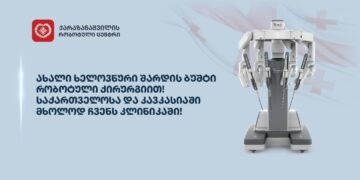
The Toumai robotic system is one of the leaders of 2025 in the field of telesurgery. With its help, operations have been performed over distances of several thousand kilometers using a 5G connection, which confirms the reliability and stability of the technology.
One of its important advantages is tactile feedback. In the case of other robotic systems, the surgeon cannot always feel tissue resistance, whereas this technology has a special program that perceives resistance. The surgeon sees and, in fact, “feels” the density of the tissue, which significantly increases the precision and safety of the operation.
Safety is ensured on several levels: the surgeon’s full control over every movement; stabilization of movement and elimination of hand tremor; strict adherence to the surgical protocol; perception of resistance. Of course, it should also be remembered that the robot does not act independently – it is a tool that expands the surgeon’s capabilities and reduces the human factor.
What has changed in the patient experience in terms of rehabilitation, duration of hospitalization, and quality of life?
The change is radical. Operations after which traditionally one or two months were needed for full rehabilitation now require only a few days. Often the patient returns home within three to seven days. Sometimes even I am surprised when I remember how rehabilitation proceeded after open surgery or laparoscopy and what this process is like now.
For example, the creation of an artificial bladder, which is considered one of the most difficult urological interventions, is a many-hour operation. In the case of the open method, rehabilitation may require two months, whereas with robotic technology the patient is already on their feet the next day and leaves the clinic within six to seven days. Pain is minimal, blood loss is almost nonexistent, and the risk of complications is significantly reduced.
In the healthcare sector, there are often complaints about the problem of patients leaving abroad. What do you think is the real reason for this?
The main factor behind patients going abroad is distrust. There are many reasons for distrust – some objective and some subjective. By introducing robotic surgery, we proved that world-class surgery can be accessible in Georgia, because unqualified and low-level surgery is incompatible with robotic surgery.
Today, there is no longer a reason for distrust. The experience, the number of operations, the complexity, and the results, which are already recognized worldwide, confirm that robotic surgeries performed in Georgia are carried out according to the same international standards and technologies as in the world’s leading clinics, although at a much more affordable price compared to Turkey and European countries.
Abroad, similar operations are often three to four times, and in some cases eight to nine times, more expensive. Added to this are the costs of travel, accommodation, and rehabilitation in a foreign environment. The introduction of robotic technology has created a real opportunity for the patient to receive world-class service in their own country.
How high is the level of interest from abroad and from which countries do you mainly receive patients?
Interest from abroad is constantly growing. Today, the share of foreign patients is approximately 10–15%, and the trend is increasing. Patients come from neighboring countries – Azerbaijan, Armenia, Russia, Kazakhstan, as well as even from the Netherlands and the USA. This is already a new stage. Georgia itself is becoming a so-called center of attraction for medical tourism.
Robotic surgery is an expensive technology. In your assessment, what balances this? What could be the economic effect of the technology in the long-term perspective?
Indeed, the introduction of robotic surgery is expensive, and the cost of traditional and robotic surgeries is also different, although in the long-term perspective it may be economically justified. It reduces the need for prolonged treatment and expensive medication therapy, the low complication rate reduces additional expenses, and accelerated rehabilitation helps the patient restore working ability more quickly. If we look at the issue systematically, it may turn out that robotic surgery causes not an increase in expenses, but optimization.
Finally, tell us about your future plans.
Our main goal is that development should not stop. Medical technologies are changing rapidly – artificial intelligence is already actively involved both in diagnostics and in surgery. Robotization is expanding in practically all directions.
I think it is important for the country to keep pace with this process. We will continue expansion and the development of robotic surgery both in our field, urology, and in other specialties as well.
source: https://shorturl.at/EqCtT