



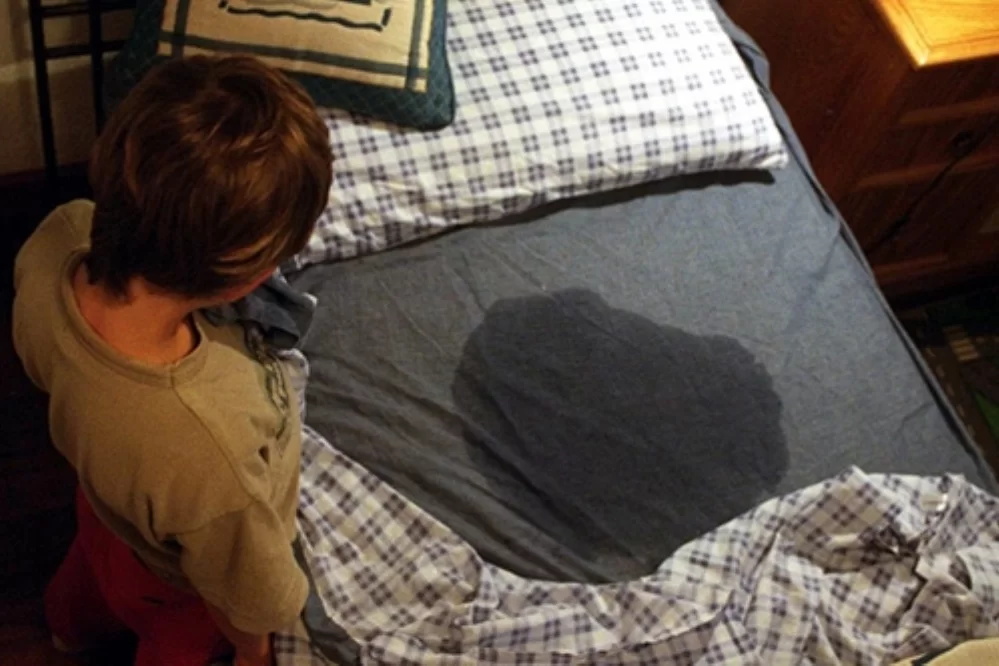
Enuresis refers to the involuntary discharge of urine from the bladder, or urinary incontinence. There are two types of urinary incontinence: daytime incontinence and nocturnal enuresis.
Enuresis is particularly common among children. It is categorized into primary and secondary forms. Primary nocturnal enuresis is caused by the underdevelopment of the reflex for urination. In secondary nocturnal enuresis, the ability to control urination, which was previously learned, is lost.
Primary nocturnal enuresis is the involuntary release of urine during sleep, occurring at least twice a week. This diagnosis is typically given to children over the age of 5 who have never had a dry period since infancy and do not have any damage to the urinary system organs.
Causes of Enuresis:
Nocturnal enuresis is a multifactorial condition, meaning it has multiple causes, including:
- Genetic factors.
- Disruption of the awakening process.
- Impaired ability to control bladder emptying.
- Endocrine factors.
- Psychological factors.
- Urodynamic issues.
- Urinary tract infections.
- Spinal cord injuries.
Primary nocturnal enuresis is not related to mental or behavioral disorders. It is also not linked to the amount of liquid consumed before sleep, although the lack of effective treatment can lead to problems later. It is associated with low self-esteem, family stress, and social isolation.
It has been established that if one parent had enuresis, the likelihood of the child having the same issue is 40-45%. If both parents had enuresis, the probability increases to 70-77%. Research is currently underway to explore the localization of genes responsible for enuresis on certain chromosomes and to study specific mechanisms involved. Let’s briefly review each factor that contributes to enuresis.
Sleep Disruption
It is known that children with nocturnal enuresis sleep deeply and have difficulty waking up. Due to the reduced activity of the arousal center, they have a diminished sense of bladder filling. Parents often wake the child up and force them to go to the bathroom. If the child fully wakes up, this can be acceptable, but if they are only partially awake, this further aggravates their condition.
Endocrine Disorders
It has been established that children with nocturnal enuresis have reduced secretion of vasopressin, the antidiuretic hormone.
As a result, water reabsorption in the renal collecting ducts decreases, and excess urine is produced at night, but the bladder cannot contain it.
Urodynamic Disorders
This term refers to the reduction in the functional capacity of the bladder.
Due to the small size of the bladder, children cannot hold the normal amount of urine produced at night.
These children often urinate frequently during the day in small amounts and experience a strong, urgent need to urinate.
Advice for Parents
First and foremost, parents should consult a family doctor or a local pediatrician. The doctor will gather detailed information about the onset and frequency of enuresis, sleep patterns, hereditary factors, psychological aspects, and urodynamic issues.
The doctor will also assess the willingness of the child and family members for long-term therapy. A general urine test with a nitrite test should be conducted.
If abnormalities are detected, a urine bacteriological test, ultrasound, micturition cystography, and urodynamic studies will be performed. Based on the results, further steps for the child’s care and treatment will be determined.
It has been established that if one parent had enuresis, the likelihood of the child having the same problem is 40-45%. If both parents had enuresis, the probability increases to 70-77%.
The parents will be explained the causes of enuresis. Parents should understand that mocking and punishing the child, in general, creates a negative atmosphere that harms the child. Never punish the child for wetting the bed at night, and especially, do not scold them in front of others. Remember, the child is more distressed by their condition than you are. Inform the child’s preschool or school teacher about their condition so that they can allow the child to go to the bathroom as soon as they express the urge to urinate, but do this discreetly so the child doesn’t notice.
Keep a diary to record wet and dry nights. After each dry night, praise and encourage the child.
Do not try to isolate the child. On the contrary, do not prevent them from spending weekends with friends or going on hikes.
It is known that wet nights are less frequent when the child is away from home. Let the child feel that they are no different from their peers.
Modern Methods of Enuresis Treatment
Currently, there are three accepted methods for treating nocturnal enuresis: behavior modification, the use of special signaling systems, and pharmacological therapy.
Since nocturnal enuresis is a common occurrence in children under 5 years old and is not considered pathological, treatment typically begins after the age of 5.
First and foremost, parents should be informed that spontaneous recovery is frequent in cases of enuresis. However, ignoring nocturnal enuresis is still not advisable.
Signaling System Treatment
In signaling system treatment, special equipment is used in which the first drop of urine activates an electrical circuit in the signaling system. As a result, the child wakes up and reflexively suppresses the act of urination, then turns off the signaling system and completes urination in the toilet. Once the child becomes accustomed to waking up as soon as the bladder fills, they continue to wear an alarm underpants for another 2 weeks. The effectiveness of this method is about 70%.
Pharmacological Therapy
If a child with nocturnal enuresis has reduced bladder capacity, the use of anticholinergic medications is indicated. For children with sleep disturbances, tricyclic antidepressants are prescribed. In cases of nocturnal polyuria, the antidiuretic hormone analog desmopressin is effective.
Psychotherapy for Secondary Nocturnal Enuresis
Most cases of secondary nocturnal enuresis are treated with psychotherapy. Therefore, once the type of nocturnal enuresis is determined, a treatment plan is developed.
The treatment is individualized and depends not only on the child’s characteristics but also on the personal traits of their parents, the degree of motivation, and the ability to be patient.
The selection of the treatment method continues until the most effective approach is found. Our goal is for the child to feel like a full member of society. Nocturnal enuresis is not a permanent sentence.
“Karazanashvili Robotic Center” offers enuresis treatment using methods that meet the standards of world medicine.