



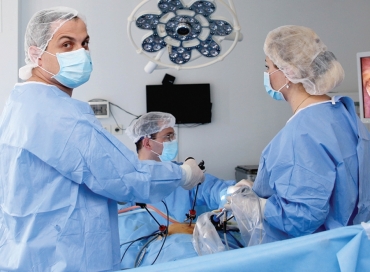
Gynecological Surgeries – When Medication Isn’t Enough
There are certain gynecological pathologies that cannot be treated with medication alone. As a result, many so-called “women’s issues” require surgical intervention. Therefore, proper planning and high-precision execution of gynecological surgeries are of utmost importance.
Which gynecological surgeries are most commonly performed? When are reconstructive methods used? And in general, which conditions require surgical treatment?
These and other important topics are discussed by Dr. David Qarsimasvili, Head of the Gynecology Department at Karazanashvili Robotic Center, a leading specialist, oncogynecologist, and endoscopic surgeon.
Dr. David is a surgeon distinguished by his vast practical experience and professionalism. In addition to his academic expertise, he is known for his exceptionally compassionate approach toward patients. His deep dedication to his work and care for his patients have earned him great admiration and affection.
Interview with Dr. David Qarsimasvili:
– Dr. David, what are the main conditions that require gynecological surgery?
– These diseases can be categorized into several groups:
-
Benign Uterine Tumors
The most common benign pathology is uterine fibroids. Surgical intervention is indicated in cases of:
- Large or rapidly growing fibroids
- Fibroids causing pain or abnormal bleeding
- Pedunculated fibroids with a risk of torsion or impaired blood flow
Surgical treatments are classified as radical or organ-preserving. For women who wish to retain their fertility, organ-preserving surgeries are performed where only the fibroids are removed while the uterus is preserved. In older patients, a total hysterectomy may be necessary.
Surgeries are performed either through open abdominal surgery or laparoscopy (endoscopic method). Most procedures today are laparoscopic. Fibroids located inside the uterine cavity are removed using a hysteroscopic resection device inserted into the uterus for visually guided removal.
-
Ovarian Cysts
Surgical removal is required for dermoid or endometriotic cysts larger than 4 cm, or in cases of torsion or rupture with internal bleeding. Small cysts usually don’t require surgery. The surgeon aims to preserve as much healthy ovarian tissue as possible.
-
Malignant Tumors
Most commonly found in the uterus, cervix, and ovaries. Early and accurate diagnosis is critical. When detected early and surgically treated correctly, many malignant gynecologic cancers can be cured.
– When is reconstructive gynecologic surgery necessary?
Reconstructive surgery is needed when there is complete or partial prolapse of the uterus or vaginal walls. If the patient is of childbearing age and wants to preserve fertility, an organ-preserving procedure is performed. If not, a radical surgery may be necessary.
Every patient is treated individually, and only after thorough assessment do we determine whether to use a laparoscopic or vaginal surgical approach. We also rule out oncological conditions before surgery planning.
For prolapse, the gold standard is laparoscopic sacrocolpopexy (promontofixation), in which synthetic mesh is used to restore the uterus and vaginal walls to their natural position.
In patients under 60, we usually preserve the ovaries due to their essential endocrine function. When appropriate, we perform laparoscopic uterine amputation and fix the mesh to both the cervix and the pelvic structures to minimize recurrence of prolapse.
– What surgeries are performed for urinary incontinence in women?
Stress urinary incontinence (leakage during coughing, sneezing, or exertion) is common. There are two main surgical options:
- TVT or TOT Surgery
A synthetic mesh is inserted via the vaginal wall and positioned under the urethra. During stress events, the mesh compresses the urethra and prevents leakage. - Burch Procedure
This involves attaching the vaginal wall to the pubic bone. It can be performed via laparoscopy or open surgery.
Other types of incontinence include:
- Urgency incontinence (caused by infections, tumors, or neurological issues)
- Mixed incontinence (both stress and urgency components)
Each case is carefully evaluated to choose the most appropriate intervention.
Interview by Tinatin Gotsadze