



Bladder cancer is a malignant neoplasm that develops from the wall of the urinary bladder.
A bladder tumor is often superficial, meaning that it does not extend beyond the mucous membrane. However, a malignant neoplasm may involve the entire bladder wall and may also metastasize.
For example, to the liver, lungs, or bone tissue. Cases of tumors invading the muscular layer account for 20–25% of malignant neoplasms of the urinary bladder.
Recurrence of bladder cancer is quite common. Therefore, patients have to undergo regular examinations and monitoring throughout their lifetime.
Risk Factors for Bladder Tumor
As with other tumor diseases, the risk of developing bladder cancer increases with age.
The risk groups include smokers and people who, due to their professional activities, are exposed to chemicals.
Various studies confirm that smokers develop bladder tumors 6 times more often than non-smokers.
Men develop malignant tumors of the urinary bladder more often than women, mainly between the ages of 45 and 65. Specialists also include people who frequently suffer from cystitis and those who frequently experience inflammation of the mucous membrane of the urinary bladder in the risk group for developing cancer. It should be noted that hereditary predisposition is considered to be of less importance in the development of this pathology.
How Bladder Cancer Manifests Itself
Symptoms of a bladder tumor include blood and pain during urination.
If the tumor formation obstructs the flow of urine from the kidneys into the urinary bladder, kidney dysfunction may develop.
The latter, in turn, manifests itself as pain in the kidney area. There are cases when a tumor that has developed in the urinary bladder blocks the urethra.
Accordingly, this creates an obstruction to the process of urine excretion, which causes difficulty and pain during urination.
The presence of blood in the urine, naturally, does not always mean that a malignant process is present. To establish a diagnosis, it is necessary to make an appointment with a doctor and undergo diagnostic evaluation.
Diagnosis of Bladder Cancer
If the doctor considers that an examination for bladder cancer is necessary, they will обязательно prescribe a urine test. If blood appears in the urine, a cytological examination will also be required. In addition, when examining for bladder cancer, urographic (X-ray contrast examination of the urinary tract and urinary bladder) and ultrasound examinations are performed. CT urography is also used to determine the exact location of the tumor formation and other important details. A full range of laboratory tests is available at Karazanashvili Robotic Center.
Treatment of Bladder Cancer
Minimally traumatic surgery is considered the “gold standard” of modern uro-oncology. Complete removal of the urinary bladder requires high-tech precision.
Laparoscopy and Its Technical Barriers
Although laparoscopy has significantly reduced invasiveness, it has certain technical barriers:
Limited movement: the instruments move rigidly and do not have wrist-like flexibility, which makes working in the narrow areas of the pelvis difficult.
Imaging: the surgeon sees a two-dimensional (2D) image, which makes depth perception relatively difficult.
Hand tremor: the equipment cannot completely neutralize the surgeon’s natural hand tremor.
Robotic Surgery for the Treatment of Bladder Cancer
Robotic surgery is a new word in modern medicine. The advantages of this method help the patient make a decision, which is why demand for this method is increasing over the years.
The robot’s instruments are more flexible than a human hand (rotating 360 degrees), which makes it possible to perform extremely precise movements in areas that the human hand cannot reach.
High-resolution imaging allows us to preserve the nerves and blood vessels as much as possible.
The system completely eliminates the risks caused by hand tremor, making the operation safer.
Robotic Surgery VS Traditional Methods
Robotic surgery for bladder cancer, compared with traditional methods, has several advantages:
With minimal blood loss, which ensures an almost painless postoperative period.
With a low risk of infection — small incisions accelerate the healing process.
With a rapid rehabilitation period: the intestines begin functioning quickly, which facilitates the patient’s rapid return to social life.
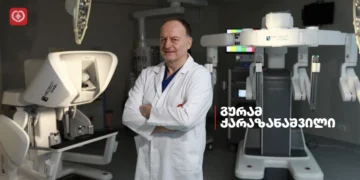
Our medical team is distinguished by a high level of professionalism. The center is headed by Professor Guram Karazanashvili — an innovator who was the first to create an artificial urinary bladder using robotic surgery and has performed up to 400 successful operations. Karazanashvili Robotic Center is the clinic with the greatest experience in robotic surgery in Georgia and the Caucasus.